

To optimize internal linking for AI search, a site should build semantic topic clusters with pillar hubs and bidirectional links, then enforce AI rules: relevance thresholds (e.g., cosine >0.6), lean link density (2–5/1,000 words), and early placements. Use concise, varied anchors mapped to headings and intent. Prioritize target pages by funnel stage and equity, with mobile-first visibility above the fold. Automate audits for orphans, broken links, and anchor ratios, and iterate via dashboards—there’s a proven sequence that maximizes results.
Key Takeaways
- Build semantic topic clusters with pillar hubs and bidirectional links to signal clear topical authority to AI crawlers.
- Use concise, descriptive anchors that mirror destination headings; rotate synonyms to maintain relevance and avoid spam signals.
- Control link density to 2–5 links per 1,000 words, prioritizing key targets early and above the fold on mobile.
- Set AI relevance thresholds for automated suggestions, audit orphan pages, and rebalance equity toward under-linked assets.
- Measure performance with dashboards tracking cluster rankings and anchor ratios, iterating quarterly based on engagement and crawl metrics.
Build Semantic Topic Clusters and a Clear Site Taxonomy

Blueprint first, links second. To optimize internal linking for AI search, the team builds semantic topic clusters atop a clear site taxonomy.
Blueprint first, links second: build semantic clusters on a clean, navigable site taxonomy.
Pillar pages act as authoritative hubs; cluster pages expand subtopics and interlink to reinforce semantic relationships. They collect keyword data, classify by intent, and group near-synonyms to form extensive clusters mapped to pillars, preventing cannibalization. Competitor analysis sets breadth and depth targets.
They prioritize content organization: clean header hierarchies, concise sections, and tables of contents streamline navigation and indexing. Topic clusters help build topical authority, improving visibility and signaling expertise to search engines.
Bidirectional links between pillars and clusters, plus lateral links among clusters, signal coherent topical ecosystems. Updating pillars with new clusters sustains authority.
The result: reduced crawl complexity, stronger topical relevance signals, clearer content relationships, and a practical blueprint AI and users can traverse efficiently.
Configure AI Linking Rules: Relevance Thresholds, Density, and Priorities

To configure AI linking rules, they should set relevance thresholds (e.g., cosine similarity >0.6, or 0.7–0.8 on larger sites) to block tangential suggestions and align with BERT/MUM expectations. AI-driven internal linking automates semantic matching and topic clustering to enhance SEO and user navigation, which helps enforce these thresholds through semantic AI. They should control link density to 2–5 per 1,000 words in long-form (lower for short-form/mobile) to prevent over-optimization while sustaining crawl efficiency. They should prioritize target pages by placing links early (first 25%), in body and conclusion, favoring pillar or high-authority pages informed by engagement signals.
Set Relevance Thresholds
While AI can surface thousands of link candidates, teams should gate them with clear relevance thresholds to protect topical integrity and impact.
Start with relevance scoring driven by semantic analysis and embeddings, then enforce a minimum similarity (e.g., 70%) so only contextually aligned pairs pass. Tools like LinkBoss visualize quality—green (75–100%), blue (49–74%), red (<49%)—to speed decisions.
Calibrate thresholds by goal: raise them for precision in cornerstone hubs; relax modestly to expand coverage across adjacent topics. Because effective internal linking can distribute authority across your site, setting appropriate thresholds ensures PageRank flows to the most relevant pages.
Combine hybrid rules and AI: restrict by taxonomy and content clusters, require per-section thresholds, and preview context before publishing.
Store title and summary embeddings in a vector database to rank candidates by similarity, promoting best matches first.
Periodically review engagement metrics to adjust thresholds, retire weak links, and reinforce high-value pages.
Control Link Density
Smart internal linking isn’t just about relevance—it’s about controlled density that preserves crawl efficiency and concentrates link equity.
He sets per-page caps—typically 3–5 links for ~1,000-word articles—and avoids exceeding 100 total links to protect user experience and internal authority. This aligns with enterprise practices where automation scales consistent linking rules across large libraries.
He calibrates link density by template: pillar pages tolerate more, while product pages stay lean. Section-level thresholds (2–3 links per major section) keep semantic coherence intact and prevent repetitive anchors or skewed linking patterns.
He applies frequency cooldowns (24–72 hours) so the same target isn’t linked repeatedly, reducing algorithm scrutiny and over-optimization risk.
Diminishing returns logic downweights targets after 10–20 internal links, redistributing equity to under-linked pages.
Finally, he monitors performance—crawl rate, bounce rate, time on page—to adjust density rules continuously.
Prioritize Target Pages
Controlled density only works if links point to the right destinations. Teams should prioritize target pages by aligning content mapping with business goals, user intent, and pillar architecture. Internal links help search engines understand site structure and pass authority, so ensure your prioritization accounts for link equity flow.
Start with conversions, SEO value, and high-impact topics, then use AI audits to surface under‑linked or orphan assets. Configure relevance thresholds so links meet a minimum semantic score, and validate with sample human reviews.
Prioritize contextual links and anchor variety to fit the target audience and funnel stage.
- Identify pillar and supporting pages; map clusters to guide links toward transactional or high‑value goals.
- Set semantic thresholds; monitor CTR and bounce to iteratively tune.
- Direct equity from authoritative pages; use anchor mixes (~60% branded, 30% natural, 10% exact).
- Reprioritize quarterly; let AI adapt as objectives and inventory evolve.
Optimize Anchor Text Variations for Intent and Natural Language

To optimize internal linking, a team should balance exact-match anchors at roughly 10% per URL and emphasize partial matches, synonyms, and branded terms for the remaining mix.
They should align anchors with query intent using concise, natural language that mirrors how users search, including question-based phrasing where appropriate.
This strategy signals semantic relevance to AI systems, reduces over-optimization risk, and improves click-through and engagement.
Balance Exact-Match Usage
While exact-match anchors still signal strong relevance, a balanced mix of anchor text types drives safer, stronger results. Data shows pages with diverse anchors gain more Google traffic and avoid spam filters.
Anchor text guidelines recommend using exact match sparingly and leaning on exact match alternatives—partial matches, synonyms, branded, generic, and naked URLs—to create a natural profile. Repetition across multiple links erodes trust and can trigger penalties.
- Keep anchors concise (under five words) and descriptive; verify they match on-page context without stuffing.
- Cap exact-match usage; rotate partial matches and semantically related terms to maintain variability.
- Audit internal links quarterly to remove duplicates, rebalance ratios, and align with evolving patterns.
- Use branded and generic anchors to dilute risk while preserving clarity; prioritize natural language that AI favors.
Align Anchors With Intent
A well-optimized internal link uses anchor text that mirrors the destination page’s intent, not just its keywords, so users and crawlers immediately grasp purpose and context. Strategic anchor alignment clarifies user intent, boosts engagement, and strengthens ranking signals per Google’s guidance. Descriptive, concise anchors outperform generic “click here” text and reduce bounce from mismatched promises. Vary anchors with natural language and synonyms to avoid manipulative exact-match patterns and to improve semantic coverage for AI search.
| Tactic | Why it Works |
|---|---|
| Mirror destination headings | Improves semantic clarity and topical authority |
| Use concise, descriptive phrases | Sets accurate expectations; aids crawl efficiency |
| Rotate synonyms and related terms | Enhances semantic relevance; lowers spam signals |
| Map anchors to content hierarchy | Helps AI parse structure and intent reliably |
Apply phrase-level, LSI-informed anchors to reflect context, not just keywords.
Strategic Link Placement and Mobile-First Usability

Because AI search now weighs internal linking patterns as signals of expertise and structure, strategic link placement must prioritize context, hierarchy, and mobile visibility.
Place links in the main body near relevant keywords to strengthen semantic mapping, and position cluster links at both the intro and conclusion to reinforce topical authority. On mobile, prioritize link visibility with above-the-fold placement, tight first-paragraph integration, and touch-friendly spacing—core to mobile optimization and AI recognition.
- Embed links in headings, subheadings, and lists; AI weights these higher for structure and relevance.
- Use descriptive, varied anchors aligned with surrounding context; avoid generic phrases.
- Elevate key pages from the homepage, breadcrumbs, and pillar hubs to clarify hierarchy.
- Maintain balanced link density; concentrate links where intent peaks, avoid hidden or collapsed placements.
Automate Link Health: Orphans, Broken Links, and Equity Distribution
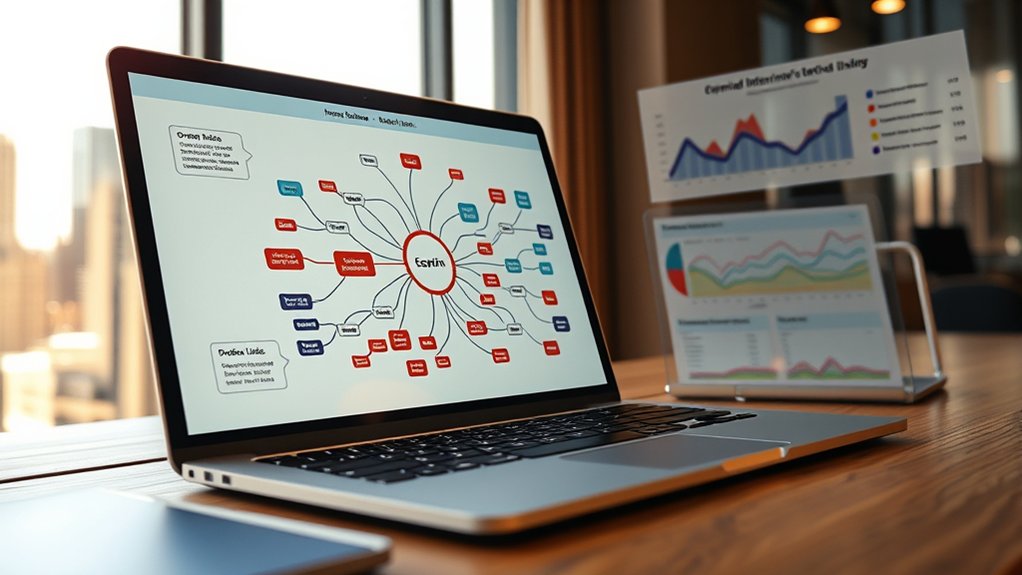
Even as content scales, teams can keep link health tight by automating detection, prioritization, and repair across broken links, orphan pages, and link equity flow.
AI-driven broken link detection runs continuous audits, flags 404s, and ranks fixes by link equity loss and traffic disruption. Automated link repair recommends redirects, removals, or anchor swaps, then validates changes in real time.
Continuous AI audits flag 404s, prioritize equity impact, and auto-repair links with real-time validation
For orphan page management, automated crawlers surface pages without inbound links, score relevance and authority, and insert contextual links from high-authority hubs into aligned topic clusters.
NLP refines anchor text and guarantees semantic coherence.
Equity distribution strategies apply PageRank sculpting at scale: models add, modify, or remove links to funnel authority to target URLs, balance dilution, and reinforce cluster depth.
Monitoring closes the loop with iterative recalibration.
Measure, Iterate, and Align With Evolving AI Algorithms

While AI reshapes how search surfaces and evaluates content, teams should treat internal linking as a measurable, testable system. They should track AI-driven ranking shifts tied to E-E-A-T, monitor AI Overview impacts (expect higher visibility with fewer clicks), and run ongoing link evaluation using click-throughs and user engagement.
Align topic clusters, anchors, and placements with semantic signals and AI crawl behavior.
1) Measure: Instrument dashboards for traffic deltas, cluster rankings, internal/external link distribution, and internal linking effectiveness scores.
2) Iterate: Refresh anchor ratios (60% branded, 30% natural, 10% exact), place 2–5 links per 1,000 words across sections, and prune or expand clusters.
3) Align: Prioritize links among pages validated by authoritative sources; use natural-language and LSI anchors.
4) Operationalize: Use Ahrefs + AI insights to surface opportunities; enable AI semantic link suggestions with human QA.
Frequently Asked Questions
How Do Internal Links Affect Crawl Budget and Server Log Patterns?
Internal links steer crawl budget by shaping link structure; they boost crawl efficiency when prioritizing key pages and eliminating broken/redirected paths. Server logs then show increased Googlebot hits on high-value URLs, shifting request frequency as links are added, removed, or consolidated.
Should Nofollow Be Used on Certain Internal Links for UX or SEO?
Yes. He applies a selective nofollow strategy to internal links like login, terms, and faceted filters for UX clarity. He avoids overuse, citing crawl-budget risks, architecture confusion, and lost equity; audits logs and coverage to validate impact.
How Do Multilingual Sites Handle Internal Linking Across Locales?
They link within each language silo, enforcing locale consistency and a clear language hierarchy. They use subdirectories or subdomains, localized anchors, self-referencing URLs, hreflang reciprocity, and canonicals. They audit regularly, fix cross-language leaks, and monitor segmented performance.
What Governance Process Ensures Editors Follow Internal Linking Standards?
They implement a documented workflow with clear ownership, editor accountability, and internal standards. Audits, CMS-enforced checkpoints, and KPIs verify compliance. Training, role-based approvals, and automated flags catch deviations, while sprint deadlines and feedback loops drive continuous, measurable adherence.
How to Reconcile Internal Linking With Faceted Navigation and Parameterized URLS?
They reconcile by limiting internal links to high-demand facets, auditing crawl logs, and prioritizing canonicalized hubs. They noindex low-value parameterized URLs, use descriptive anchors, monitor link equity, whitelist valuable faceted navigation combinations, and surface them via sitemaps, breadcrumbs, and analytics thresholds.
Conclusion
Optimizing internal links for AI search isn’t guesswork—it’s a system. Teams should build semantic clusters, enforce clear taxonomies, and configure relevance thresholds, density caps, and priorities. They’ll diversify anchor text to match intent, place links where users engage most—especially on mobile—and automate audits for orphans, broken paths, and equity flow. Track click-through, crawl paths, dwell time, and assisted conversions. Iterate against model updates and logs. The result: stronger discovery, higher topical authority, and compounding organic growth.
