

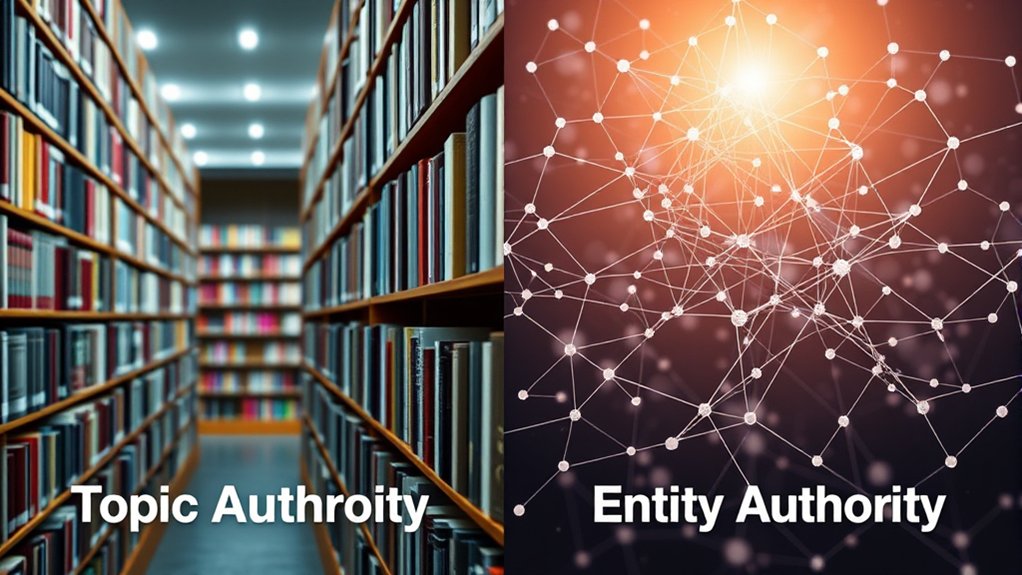
Topic authority shows a site’s breadth and depth on a subject via extensive coverage, strong internal linking, and intent-mapped clusters. Entity authority reflects web-wide credibility of a defined entity (brand, person, product), validated by structured data, consistent facts, citations, and mentions. Topic authority scales rankings across many related queries; entity authority boosts visibility for specific, intent-led searches and surfaces in panels and answer boxes. Track coverage, SERP share, schema validation, and citation frequency. The next sections unpack strategy, KPIs, and implementation.
Key Takeaways
- Topic authority is expertise across a subject via comprehensive, high-quality coverage; entity authority is web-wide credibility of a specific, identifiable entity.
- Topic authority is built through pillar hubs, exhaustive content clusters, and internal linking that satisfy varied intent within a subject.
- Entity authority grows from verified mentions, citations, structured data (JSON-LD), and consistent facts across authoritative sources.
- Topic authority scales rankings across many related queries; entity authority boosts visibility for entity-specific and semantic queries.
- Measure topic authority by coverage completeness and SERP share; measure entity authority by schema validation and citation frequency.
Defining Topic Authority and Entity Authority

Clarity matters: topic authority captures a site’s proven expertise within a specific subject, earned by consistently publishing thorough, high‑quality content that answers user intent across a topic and its subtopics; entity authority reflects the web-wide credibility of a distinct thing (person, brand, product, place, idea) as recognized by search engines through signals like mentions, backlinks, and structured data. Because Google increasingly emphasizes understanding user intent through semantic search, building topical authority signals strong relevancy that can improve how content is matched to queries.
Defining both requires separating topic expertise from reputation signals. Topic authority centers on extensive coverage: pillar pages, clustered subtopics, and in-depth answers that demonstrate content reliability.
It’s measured by how completely a site addresses questions, not by domain-wide metrics alone. Entity authority, by contrast, depends on recognition of the entity itself—brand mentions, authoritative citations, reviews, structured data, and consistent references across the web.
Strong entity authority often surfaces in knowledge panels and rich results.
Why the Distinction Matters for SEO

For ranking strategy alignment, a team should map topical authority to cluster breadth and internal linking, and map entity authority to structured data, entity co-occurrences, and snippet/knowledge panel eligibility. To maximize search relevance, ensure comprehensive coverage of core topics and their related entities to signal topical authority to search engines. They should track KPIs accordingly: coverage completeness, query set growth, and SERP share for topical authority; entity consistency, schema validation, snippet and knowledge panel wins, and AI citation frequency for entity authority. This distinction guarantees precise optimization levers and prevents misattributing gains across rankings, UX, and generative AI visibility.
Ranking Strategy Alignment
Although both signals matter, aligning ranking strategy to topic vs. entity authority changes what gets built, linked, and measured. For topic authority, teams prioritize pillar hubs, exhaustive clusters, and internal links that surface breadth. For entity authority, they engineer pages around specific concepts, tighten keyword optimization to search intent, and interlink entities to elevate content relevance. Ranking algorithms reward coherent architectures, clear authority signals, and resilient coverage that withstands algorithm updates. Competitive analysis exposes content gaps; closing them drives user engagement and search visibility. Search engines analyze content based on related entities rather than just keyword frequency, which means content that reflects Entity SEO is more likely to be understood and ranked appropriately.
| Focus | Build & Link | Targeting |
|---|---|---|
| Topic authority | Pillars + clusters; hub links | Broad terms + long-tail |
| Entity authority | Entity pages; semantic links | Precise, intent-driven queries |
| Hybrid | Cross-entity bridges | Maximize coverage efficiently |
Strategically, topic breadth earns trust; entity depth secures precise matches.
Measurement and KPIs
Two distinct KPI sets keep teams honest: topic authority gauges breadth, while entity authority proves trust.
Measurement techniques differ, so teams must track performance indicators that align to goals. For topics, they monitor long‑tail capture and coverage across clusters; for entities, they validate credibility signals and recognition. Semantic networks help structure and interconnect content, enhancing both user experience and search engine understanding.
Tools like Ahrefs, SEMrush, and Clearscope quantify keyword coverage, while schema, citations, and E-E-A-T bolster entity signals. Both sets inform resilience against algorithm shifts.
- Track pages ranking across subtopics and related questions versus competitors
- Measure organic traffic growth and share of voice within topic clusters
- Audit internal linking strength supporting topical depth and navigation
- Validate schema implementation, Knowledge Graph presence, and featured snippets
- Monitor entity mentions, backlink diversity, author credentials, and reviews
Together, these performance indicators reveal breadth and trust, guiding strategic SEO investment.
Core Differences Between Topic and Entity Authority

While both shape how search engines evaluate relevance and trust, topic authority and entity authority diverge in scope, signals, and use cases.
The core distinctions between these authority types start with focus: topic authority spans a subject’s breadth and depth; entity authority targets identifiable people, products, organizations, or concepts. Newer sites may prioritize depth in fewer topics to build topical authority efficiently before expanding their scope.
Topic authority relies on extensive coverage, semantic structure, and internal linking; entity authority leans on verified entity mentions, schema markup, authoritative external connections, and knowledge panel presence.
Search engines favor topic authority for broad informational queries and entity authority for specific, entity-first intents.
Structurally, topic authority is hub-and-spoke with pillars and clusters; entity authority is entity-centric, built on semantic relationships.
Outcomes differ: topic authority scales rankings across related keywords, while entity authority boosts visibility for entity queries and featured snippets.
Both align with E-E-A-T.
Building Topic Authority: Pillars, Clusters, and Coverage

Because topical authority compounds across a site, teams should architect content with pillars, clusters, and rigorous coverage that map to user intent.
Pillar development starts with a 2,000–3,000+ word hub that targets broad, high-volume queries, segments sections with anchors, and introduces subtopics without cannibalizing details.
Cluster optimization then deepens coverage on long-tail intents, links back to the pillar, and interlinks laterally to reinforce semantic signals and pass equity.
- Define the core theme, audience intents, and gaps; prioritize by search demand and business value.
- Draft the pillar with clear sections; map each section to a corresponding cluster plan.
- Build clusters around discrete questions and pain points; avoid overlap via unique targets.
- Use descriptive anchors; implement hub-and-spoke internal linking.
- Continuously expand and refresh clusters to sustain coverage and performance.
Building Entity Authority: Entities, Relationships, and Verification

Even as topical coverage matures, real authority crystallizes when a site anchors content to verifiable entities, maps their relationships, and proves credibility. An entity is a uniquely identifiable concept—people, organizations, products, locations, or ideas—recognized beyond keywords. Teams research competitors, confirm entries in Wikipedia/Wikidata, and apply schema to define entities precisely. They then map entity relationships via knowledge graphs, align contextual attributes, and connect internal pages to display breadth and depth. Verification processes cross-reference authoritative sources, reinforce E-E-A-T, and tie claims to established organizations where possible.
| Step | Action | Evidence Signal |
|---|---|---|
| Identify | Confirm entity in Wikidata | Stable Q-ID |
| Define | Add schema (Thing subtype) | Valid JSON-LD |
| Map | Link related sub-entities | Graph coverage |
| Verify | Cite authoritative sources | Consistent facts |
Natural placement in headers, FAQs, and body cements clarity without stuffing.
Measuring Impact on Rankings and Visibility
Anchoring content to verified entities sets the stage to quantify results. Measuring impact metrics requires tracking how topic and entity authority shift rankings and visibility trends across SERPs.
Data shows entity-optimized pages drive a 32% average lift in organic visibility, while extensive topic coverage expands rankings from broad to long‑tail terms and stabilizes performance through updates.
- Higher topical authority correlates with multi-keyword ranking gains and featured snippet eligibility.
- Entity-rich pages increase presence in answer boxes, AI results, and knowledge panels.
- Strong internal linking and entity mapping improve crawlability, indexing, and SERP feature reach.
- Authority clusters lift CTR, dwell time, page views per session, and reduce bounce.
- Breadth, depth, semantic proximity, and entity coverage align with better ranking performance.
These signals compound, building durable traffic and consistent SERP prominence.
Practical Framework to Align Topic and Entity Strategies

To operationalize alignment, the team builds a unified topic-entity map that links core themes to defined entities, attributes, and relationships using structured data.
They then plan content clusters where pillar pages cover topics and cluster assets target entity-specific intents, supported by rigorous internal linking.
Finally, they set measurement and iteration steps—tracking entity recognition, topic coverage gaps, and cluster performance—to refine priorities and scale what works.
Unified Topic-Entity Map
While keywords still matter, a unified topic-entity map becomes the strategic backbone that aligns broad themes with the specific entities that embody them.
Through unified mapping and explicit semantic relationships, it ties pillar topics to sub-entities, clarifying context for users and search engines.
Pillar pages set scope; cluster pages codify attributes, ownership, and connections via schema markup, reinforcing relevance signals.
The result: stronger topical authority, cleaner navigation, and measurable coverage of intent.
- Define pillar topics, enumerate sub-entities, and model semantic relationships in a layered hierarchy.
- Use Schema.org/JSON-LD to mark entities, attributes, and relations for machine readability.
- Interlink entity and topic nodes to concentrate internal link equity and reduce orphan content.
- Leverage graph-based tools and ontologies to visualize gaps and coverage.
- Audit completeness by mapping intents to entities, subtopics, and supporting evidence.
Content Clusters With Entities
Because search engines interpret meaning through entities, content clusters should center on a primary entity with a pillar page and tightly scoped cluster pages that cover related entities, attributes, and intents.
Teams start with entity extraction and validate a strong knowledge base match, then plan Content organization via Knowledge mapping that clarifies Entity relationships and Content hierarchy.
Use keyword tools to prioritize entity-based subtopics by Topic relevance and search volume. Build cluster pages that deepen Semantic relevance through associated entities and attributes.
Execute Internal linking with entity-focused anchors, including synonyms, to strengthen Authority demonstration and User navigation.
A hub-and-spoke structure replaces silos, aligning Search engine optimization with user pathways. Expand breadth across 2–3 key entities and depth within each sub-entity to signal thorough coverage.
Measurement and Iteration Steps
Content clusters anchored in entities only generate compounding gains when teams measure what matters and iterate with intent.
He ties topic authority to Topic Share, depth of coverage, backlinks/mentions, final answer rate, and cluster-level rankings.
She pairs entity authority with verification status, featured snippets, knowledge panels, semantic query lift, and attribute completeness.
The plan relies on rigorous measurement techniques and disciplined iteration processes that connect clusters to entity graphs.
- Audit breadth/depth; expand original pages to close subtopic gaps.
- Track Topic Share and cluster rankings; prioritize pages that shift category share.
- Strengthen authoritative links/mentions; target sources embedded in the topic space.
- Monitor final answer rate; refine content to complete journeys and win snippets.
- Maintain entity maps; verify profiles, optimize for panels, and improve semantic performance.
Finally, merge metrics for unified decisions and refresh quarterly.
Frequently Asked Questions
How Long Does It Take to See Authority Improvements?
They typically see authority improvements within 3–12 months. The authority timeline accelerates after 6–9 months. Impact factors include content cadence, internal linking, backlinks, crawl frequency, and domain strength. Early signals: rising long-tail traffic, CTR gains, and snippet appearances.
What Tools Best Visualize Entity Relationships and Graphs?
They’d prioritize entity graphing tools like Azimutt, SchemaSpy, and PuppyGraph, plus relationship mapping software such as TheBrain and mind maps. Teams should add Lucidchart, dbdiagram.io, and ERD Lab for collaboration, reverse engineering, and API/SVG embeddings.
How Should Small Sites Prioritize Limited Resources?
They should prioritize resource allocation to core revenue goals, optimize performance, and streamline workflows. He focuses content strategy on high-impact pillars and clusters, updates top converters first, compresses assets, enables caching, tracks KPIs weekly, and cuts low-yield initiatives relentlessly.
Can Authority Decline Without Publishing New Content?
Yes. He can see authority metrics decay without new posts as content relevance fades, competitors publish, links atrophy, and intent shifts. He should audit, refresh updates, optimize internal links, and track engagement to stabilize rankings despite limited publishing.
How Do Multilingual Sites Handle Topic and Entity Alignment?
They align topics and entities using multilingual strategies: schema.org markup, SameAs links to Wikidata/Wikipedia, entity translation via MEL, graph-embedding alignment, k-NN matching, and internal linking. They cluster content, map intents per language, and continuously harmonize knowledge bases.
Conclusion
In closing, the article shows that topic authority drives depth and coverage, while entity authority signals identity, credibility, and real‑world connections. Treating them as complementary boosts rankings, crawl efficiency, and SERP eligibility. Teams should map pillars and clusters to key entities, validate relationships with structured data, and track gains via impressions, query breadth, Knowledge Panel presence, and link velocity. The data point one way: align content architecture and entity verification to compound visibility and trust at scale.
