

Plan “complete” AI clusters by defining workload profiles and SLOs (latency <100 ms, 99.5% availability, accuracy thresholds), mapping CPU/GPU/memory/storage to goals, and enforcing automated scaling and acceptance tests. Select A100/H100 or TPUs, NVMe, and high-thread CPUs; right-size batches to raise MFU. Design 400/800G RDMA networks, consistent MTU, and liquid cooling for low latency and reliable thermals. Build a minimal viable cluster, validate with realistic queries, and structure intent-led internal links. Practical steps and proofs follow.
Key Takeaways
- Define a minimal viable cluster with clear user intents, business impact, and acceptance criteria for coverage, SLO conformance, and integration tests.
- Select 4–6 high-impact subtopics, map each to primary intent, and assign representative, non-overlapping queries to prevent cannibalization.
- Structure pillar and cluster pages with consistent H2/H3 hierarchies, and classify pages to align content with intent and outcomes.
- Implement bi-directional, contextual internal links, auditing quarterly to fix breakage, remove orphaned pages, and reinforce topical authority.
- Validate completeness using realistic query simulations and AI coverage tools, then iterate based on gaps in relevance, depth, and intent alignment.
Define Workload Profiles, SLOs, and Acceptance Criteria

Although teams often jump to tooling, planning starts by defining workload profiles, SLOs, and acceptance criteria that translate business outcomes into concrete cluster behavior.
Teams specify profiles for training, inference, and data prep, mapping CPU, memory, GPU, and storage to workload optimization goals: general-purpose for balance, memory-optimized for large datasets, GPU-enabled for compute-intensive runs. Unified observability that ties model metrics to infrastructure health helps ensure profiles deliver intended outcomes across environments by detecting bottlenecks in underlying infrastructure.
Define training, inference, and data prep profiles that map CPU, memory, GPU, and storage to optimization goals.
Profiles integrate with Kubernetes and Helm so high-level intents become repeatable resources.
SLOs codify targets with performance metrics: inference latency (<100 ms), throughput, training job completion time, availability (e.g., 99.5%), and accuracy thresholds.
They drive fair, automated scheduling and dynamic scaling policies.
Acceptance criteria verify readiness: SLO conformance, resource limits, governance, failover, and integration tests.
Validation uses canaries, A/B tests, and monitoring to detect drift and enforce consistency.
Select Hardware Aligned to Training, Inference, and I/O Demands
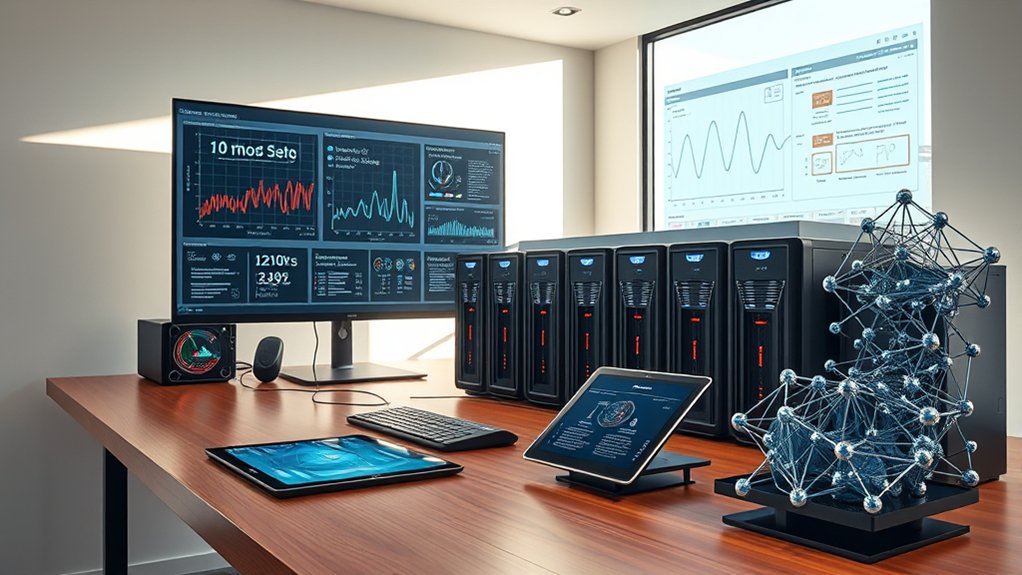
With workload profiles and SLOs defined, teams can map targets to concrete hardware choices that meet training, inference, and I/O demands.
For training, they select NVIDIA A100/H100 or TPUs, pair them with 16+ thread Intel Xeon or AMD EPYC CPUs, and provision 128GB+ RAM. GPU utilization strategies include right-sizing batch, activation checkpointing, and NVLink/NVSwitch selection. AI primarily runs on GPUs, so selecting the right class of accelerator (A100/H100 or equivalent) directly impacts throughput and cost efficiency.
CPU optimization techniques focus on parallel data loaders, pinned memory, and efficient augmentation.
For inference, they match hardware to latency and concurrency: CPUs for lightweight models, GPUs or accelerators for real-time workloads, and FPGAs at the edge.
NVMe SSDs (1TB+) sustain fast checkpoints and weight loads; streaming or parallel file systems prevent stalls.
Grace-class CPU-GPU memory coupling and ample PCIe lanes reduce bottlenecks and protect throughput.
Architect Networking and Facilities for Low Latency and Scale

To hit strict SLA targets, the team specifies low-latency interconnects (400/800G, RDMA-capable) and verifies consistent end-to-end MTU to prevent fragmentation and jitter.
They instrument links and workloads to quantify microseconds per hop and measure throughput efficiency during All-Reduce and All-to-All patterns.
In parallel, facilities planning guarantees scalable cooling capacity—air or liquid—matched to rack densities and growth curves so thermal headroom never throttles GPUs. Additionally, the architecture incorporates dedicated networks for compute, storage, and management to ensure predictable performance and scalability.
Low-Latency Interconnects
Because AI training amplifies microseconds into stalled GPUs and wasted dollars, architects design interconnects that minimize hops, queueing, and distance while sustaining line-rate throughput at scale.
They prioritize optical components with minimal processing, DWDM for bandwidth efficiency, and shortened fiber distance between sites to achieve latency reduction. For example, architects account for the roughly 5 microseconds per kilometer inherent in fiber to minimize transport latency.
Pragmatic network architectures—leaf-spine Clos or flat two-tier—use topology symmetry, 1:1 oversubscription, and ECMP to prevent hotspots.
Torus fabrics cut hop count and switching delay while offering path diversity.
Lossless transport via RoCEv2, reinforced by congestion management using PFC, ECN, and AFD, curbs retransmissions and buffers.
Within facilities, direct cross connects and collapsed stages remove avoidable microseconds.
PCIe 4.0 NICs and 400Gbps links maintain throughput, while avoiding extra mux/demux stages preserves deterministic latency at scale.
Consistent End-To-End MTU
Few tuning knobs move the needle on AI cluster efficiency as much as a consistent end-to-end MTU. MTU configuration defines packet size without packet fragmentation; inconsistencies inflate network latency, retransmits, and CPU cost. For AI throughput, prioritize network consistency: set identical MTUs on NICs, switches, and routers, validate with PMTUD, and prefer jumbo frames (e.g., 9000) on back-end fabrics and storage paths. Larger frames lift protocol efficiency by reducing per-packet overhead, especially for RoCEv2 and other RDMA traffic. Enforce change control and performance monitoring to catch mismatches early. Because larger MTUs improve efficiency but can increase delay variation, validate that application latency SLOs are still met during scale-up.
| Scope | Target MTU | Validation |
|---|---|---|
| AI fabric | 9000 | PMTUD, loss checks |
| Front-end | 1500–9000 (segmented) | ICMP, traceroute |
| Edge/PPPoE | 1492 | Large-ping tests |
Audit after expansions; test with large packets; alert on drops and fragmentation.
Scalable Cooling Capacity
While GPUs race faster each quarter, cooling capacity often sets the real ceiling for AI scale. Clusters now push 50–100 kW per rack and will stretch to 200–250 kW, so teams should adopt liquid cooling and a modular architecture that expands incrementally.
Direct-to-chip and immersion systems eliminate fan overhead, cut PUE, and tame chip-level heat spikes that create hotspots and throttling. Multi‑mode readiness—hybrid air and liquid—adds flexibility and redundancy, while independent cooling loops prevent single-point failures.
Facilities and network planning must align: rack orientation, airflow, and power distribution affect thermal efficiency and latency. Deploy intelligent thermal controls and AI-driven policies to match cooling to real-time load, reducing energy consumption (25–40% share) and water use.
Favor water-efficient coolants and renewables to shrink footprint.
Build a Minimal Viable Cluster and Validate With Realistic Tests

Instead of chasing exhaustive coverage, teams should define a minimal viable cluster that hits essential user intents, validates against measurable criteria, and proves business impact fast.
Start by scoping only subtopics that directly support the pillar and strengthen cluster coherence. Let business goals, not keyword counts, drive selection. Each subtopic must map to a distinct user intent—informational, transactional, or commercial—and exclude tangential or redundant angles.
Pick 4–6 representative subtopics using search volume, relevance, and expected impact, with AI suggestions vetted manually.
Define acceptance criteria upfront: coverage benchmarks, target keywords, intent alignment, and semantic diversity thresholds.
Run realistic tests: simulate queries, audit with AI coverage tools, review SERPs, and spot duplication.
Iterate ruthlessly—add missing intent, prune overlap, adjust depth—and document decisions for repeatability.
Structure Topic Clusters With Clear Intent and Internal Linking

With a minimal viable cluster defined and validated, the next lever is structure: map each topic to a primary intent (informational, navigational, transactional, commercial), pick representative queries with clear scope, and prevent cannibalization. He classifies every page for intent clarity, aligns queries to business outcomes, and prioritizes long-tail subtopics with conversion potential. He implements a pillar as the canonical source, then adds cluster pages with clear H2/H3 hierarchies. Bi-directional internal linking reinforces topical authority, while contextual anchors reduce ambiguity and boost discovery. He audits links quarterly to remove breakage and orphaned pages. AI tools surface entities, validate demand, and flag overlaps; humans finalize scope.
| Page Type | Primary Intent | Anchor Strategy |
|---|---|---|
| Pillar | Informational | Generic head term |
| Cluster | Commercial | Feature/benefit phrase |
| Cluster | Transactional | Action-oriented CTA |
Optimize Operations for Efficiency, Reliability, and Sustainability

Three levers determine whether AI clusters deliver ROI at scale: efficiency, reliability, and sustainability.
Teams should drive Maximizing Model FLOPS Utilization beyond industry norms—CoreWeave’s >50% MFU on NVIDIA Hopper shows up to 20% performance gains—by removing bottlenecks across compute, networking, storage, and management.
Pair performance monitoring with AI-agent fleet management to automate detection, planning, and task execution, while RLHF closes the loop to refine resource allocation and stability.
1) Raise MFU: eliminate idle cycles, right-size batch/sequence configs, and tune kernels to operate closer to theoretical peak, accelerating timelines and lowering model costs.
2) Engineer for scale: design high-speed, low-loss networks; simulate (e.g., Arcadia) to preempt stalls and packet retransmissions.
3) Make power a feature: adopt liquid/immersion cooling, carbon-aware scheduling, and workload prioritization to cut energy and extend hardware life.
Frequently Asked Questions
How Do We Budget and Forecast TCO Over a Three-Year Cluster Lifecycle?
They budget by annualizing CapEx, modeling OpEx, and performing lifecycle analysis. They forecast total cost using workload hours, power, cooling, staffing, maintenance, and software overhead, iterate quarterly, compare on-prem vs cloud break-even, and reserve contingency for scalability and compliance.
What Compliance Frameworks Apply to AI Clusters Handling Sensitive Data?
They apply GDPR, HIPAA, SOC 2, EU AI Act, and ISO/IEC 27001. He enforces data privacy via encryption and access controls, drives regulatory compliance with documentation, conducts risk assessment, and hardens security protocols with monitoring, auditing, incident response, and bias mitigation.
How Should Teams Be Organized and Staffed to Operate the Cluster?
They organize around team structure and clear role definition: functional or matrix for scale, flat for startups. They staff MLEs, data scientists, engineers, ethicists, governance leads. They set SMART goals, enforce MLOps, conduct scheduled reviews, and track reliability, cost, and quality outcomes.
What Change-Management Process Governs Upgrades Without Disrupting Workloads?
They enforce a formal change management process: phased rollouts, maintenance windows, orchestration-controlled scheduling, real-time SLO monitoring, automated rollback, and stakeholder communications. This governance safeguards workload continuity, quantifies impact against baselines, and iteratively improves procedures through post-upgrade validation, audit trails, and feedback loops.
How Do We Plan for Multi-Cloud or Hybrid Burst Capacity Integration?
They plan multi-cloud or hybrid burst capacity by conducting capacity planning, defining triggers, and aligning cloud configuration. They quantify bandwidth, latency, and egress costs, enforce compliance, synchronize state, automate failover, and measure outcomes: SLA adherence, cost-per-request, and GPU utilization.
Conclusion
In closing, the article shows that disciplined planning drives AI-ready clusters. Teams define workload profiles, SLOs, and acceptance criteria, then choose hardware for training, inference, and I/O. They design low-latency networks, validate a minimal cluster with realistic tests, and structure topic clusters for intent and internal linking. Operations prioritize automation, observability, and sustainability. The outcome: predictable performance, faster time-to-value, lower TCO, and scalable capacity that meets real SLOs. Data guides every decision, and results prove completeness.
