

AI compresses the funnel by generating intent-aligned content faster, structuring outlines, and lifting ad CTR by 38% while cutting planning time up to 50% and boosting conversions 36% (with 97% human oversight). It powers dynamic segmentation to serve personalized journeys, then unifies data for multi-touch attribution, predictive insights, and 202% stronger CTAs. Budgets auto-shift to high-LTV channels via programmatic optimization. As AI-driven journeys grow non-linear, resource hubs and intent scoring guide buyers—what follows shows how to operationalize it.
Key Takeaways
- AI accelerates content ideation and structuring, cutting planning time and lifting CTR and conversions across funnel stages.
- Machine learning enables dynamic segmentation and personalization, improving targeting accuracy, conversions, and resource allocation at scale.
- Unified analytics and multi-touch attribution reveal true channel impact, with predictive insights guiding high-converting CTAs and next actions.
- Real-time budget optimization shifts spend to high-impact channels and creatives, using revenue-weighted metrics to lower CAC and raise ROI.
- AI reshapes non-linear buyer journeys with generative answers and intent scoring, improving discovery, consideration, and orchestration across TOFU, MOFU, and BOFU.
AI-Driven Content Creation Across the Funnel
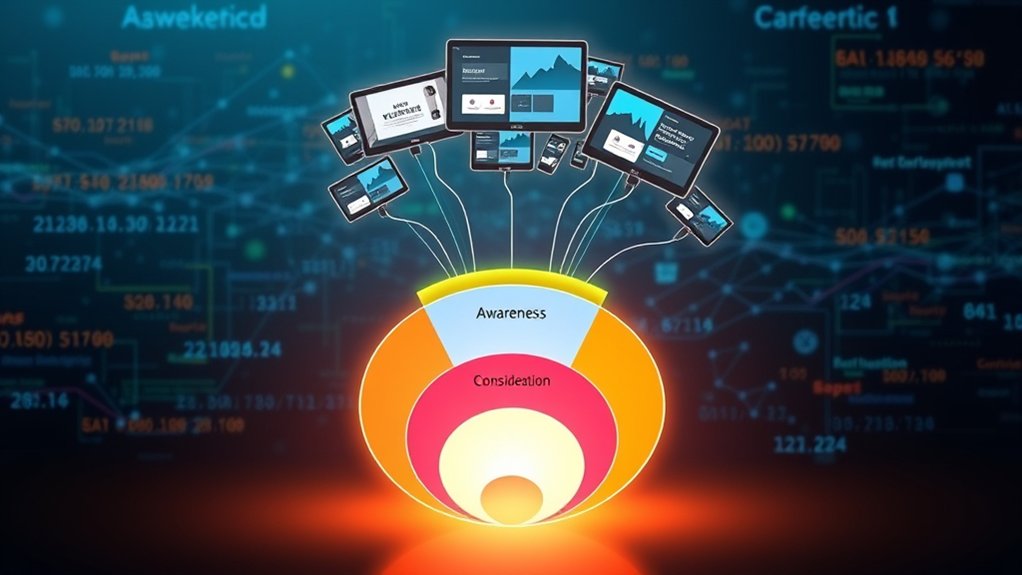
Although the funnel hasn’t changed, AI now accelerates every stage of content creation with measurable lift.
Teams deploy AI ideation techniques and AI driven brainstorming to mine trends, surface customer questions, and prioritize high-potential topics—used by 68–76% of marketers and tied to a 38% CTR lift in ad copy.
Next, AI content structuring generates outlines aligned to intent and keywords, cutting planning time by up to 50% and correlating with a 36% conversion uplift. Additionally, 97% of companies apply human oversight to AI-generated content to ensure accuracy and brand safety.
AI content structuring aligns intent and keywords, halving planning time and driving 36% conversion uplift
For production, AI content generation expands output (17 vs. 12 monthly articles) while supporting dynamic emails, pages, and ads.
Post-publish, AI content optimization refreshes assets, driving 120% blog traffic growth.
Finally, AI audience targeting and analytics guide cadence, formats, and AI engagement strategies to maximize AI content performance.
Smarter Segmentation and Personalization at Scale

With AI accelerating content creation across the funnel, the next performance release comes from smarter segmentation and personalization at scale. Teams deploy dynamic targeting powered by behavioral insights—purchasing history, engagement patterns, and real-time preferences—to adapt segments continuously. By 2025, marketers increasingly rely on AI-powered segmentation to deliver highly personalized experiences that drive measurable growth.
Machine learning synthesizes structured and unstructured data to surface granular drivers of response, lifting targeting accuracy and campaign ROI.
A practical framework emerges:
- Sense: ingest consented data; apply anonymization, differential privacy, and federated learning to protect identities.
- Segment: create fluid micro-segments and synthetic personas/digital twins that mirror evolving needs.
- Serve: auto-generate personalized emails, ads, and landing pages calibrated to segment intent.
- Stream: iterate creatives rapidly as signals change.
Personalization engines orchestrate offers across touchpoints, aligning content to individual context. Outcomes include higher conversions, better resource allocation, and sustained relevance across markets.
Analytics, Attribution, and Predictive Insights

Even as creative output scales, performance gains hinge on AI that measures, attributes, and predicts across the funnel.
AI unifies multichannel data, applies advanced models, and turns signals into data insights that improve funnel performance. It validates incremental impact with multi-touch attribution, forecasts outcomes, and surfaces risks like churn. Personalized CTAs can dramatically lift results, with 202% better conversion than generic alternatives, underscoring how AI-driven segmentation and real-time decisioning deepen funnel efficiency.
AI unifies multichannel data, applies models, and turns signals into insights that boost funnel performance and reduce churn.
Conversational analytics lowers the barrier to action, so teams ask questions in plain language and get instant, defensible answers.
1) Measurement: Centralize structured and unstructured inputs, automate QA, and standardize metrics for stage-level clarity.
2) Attribution: Use daily-updated, algorithmic models to credit influential touchpoints and prove causal lift from targeting and personalization.
3) Prediction: Score leads, flag bottlenecks, and set realistic KPIs with scenario planning.
These disciplines create a closed-loop system that prioritizes what actually moves the funnel.
Budget Optimization and Media Placement Automation

Something powerful happens when AI turns attribution and lift signals into budget actions. It continuously reallocates spend toward channels, cohorts, and creatives that prove incremental impact, replacing slow cycles with real time adjustments.
A practical framework: anchor decisions to revenue-weighted metrics—CAC payback by cohort, LTV:CAC—and set guardrails that throttle investment into high-intent segments while pausing underperformers. Programmatic algorithms optimize bids to predicted value and conversion likelihood, improving budget efficiency and ROI. Full-Funnel Optimization connects TOFU, MOFU, and BOFU with a shared data layer, enabling insights and budgets to flow across stages for faster feedback loops and coordinated messaging.
Cross-channel models refine media mix and placement by stage, routing spend to high-friction templates like pricing, demo, or checkout when they lift conversion.
Automated systems test creative and offers at scale, shifting dollars to combinations that lower CPA or raise CTR. The result: fewer wasted impressions, faster scaling, and tighter payback.
Rethinking the Buyer Journey for AI-First Discovery

Although buyers still research across channels, AI now orchestrates discovery: generative answers compress search, zero-click results lift engagement quality while lowering visits, and agentic assistants begin vendor screening. Organizations must build unified AI strategies focused on innovation through efficiency, aligning with rising expectations for AI ROI.
Buyer exploration becomes non-linear, collapsing discovery, evaluation, and purchase. Marketers should prioritize journey optimization through AI-driven segmentation, predictive intent scoring, and schema-rich product pages that feed AI summaries and comparisons.
Buyer journeys are non-linear—optimize with AI segmentation, intent scoring, and schema-rich pages powering AI summaries.
- Quantify intent: 61% already use AI intent data; integrate behavioral scoring and sentiment to trigger timely, personalized outreach that boosts satisfaction and loyalty.
- Structure for synthesis: build authoritative resource hubs, FAQs, and comparison Q&A with markup to increase AI citation and steer consideration.
- Orchestrate adaptively: compose CDPs with real-time AI to personalize paths; prepare for agentic AI to design and optimize journeys autonomously as journey analytics scale from $14.49B to $53.47B by 2030.
Frequently Asked Questions
How Do We Ensure Ai-Generated Content Meets Legal and Compliance Standards?
They enforce legal standards by labeling outputs, securing consented data, ensuring content accuracy via multi-layer reviews, and documenting compliance auditing. They deploy IP-safe datasets, human oversight, risk assessments, and governance workflows, with ongoing monitoring, security controls, and model updates aligned to GDPR, CCPA, HIPAA.
What Governance Framework Should Oversee AI Marketing Tools and Data Usage?
They recommend a cross-functional governance framework with executive sponsorship, ethical guidelines, and data stewardship. It defines roles, policy-as-code controls, bias detection, audits, and continuous monitoring. It aligns with EU AI Act/ISO, mandates training, decision trees, and feedback loops.
How Can Teams Upskill for AI Without Disrupting Current Operations?
They upskill through microlearning on daily tasks, piloted tools, and scenario-based practice. They maintain operational balance with phased rollouts, clear KPIs, and feedback loops. Skill development emphasizes data literacy, critical evaluation, and human–AI collaboration, proving incremental productivity gains and minimizing disruption.
Which Privacy Practices Maintain Trust While Using Behavioral Data?
They maintain trust by enforcing data transparency, explicit user consent via CMPs, first-party data focus, minimal necessary collection, encryption and anonymization, CDPs and clean rooms, easy opt-outs, timely policy updates, and privacy education—forming a measurable, governance-first framework with strategic foresight.
How Do We Measure Ai’s Environmental and Computational Costs?
They measure AI’s environmental and computational costs by tracking kWh, PUE, carbon intensity, and water usage per task; auditing model training/inference; enforcing algorithm transparency; benchmarking energy efficiency; applying lifecycle assessments; and integrating vendor ESG disclosures into procurement scorecards and governance dashboards.
Conclusion
AI’s reshaping the funnel with data-driven precision and operational speed. Teams that fuse AI content engines, dynamic segmentation, and predictive analytics outperform on CAC, LTV, and velocity. Practical frameworks—like intent tiers, next-best-action models, and MMM + MTA hybrids—turn insights into repeatable playbooks. Automated budget pacing and media placement compound gains. As AI-first discovery grows, marketers must redesign journeys around signals, not stages—shipping fast experiments, measuring incrementality, and scaling what works with disciplined governance.
