

Topical authority is a measurable signal of expertise built by thorough coverage, semantic structure, and credible authorship. AI-led SERPs reward sites that map topic universes, publish pillars and clusters, optimize internal links, and keep content updated with citations. Use Ahrefs/Semrush, Search Console, and NLP tools to target intent-rich queries, close gaps, and track Authority Signal KPIs: ranking distribution, topic share, indexed depth, engagement, and link equity. Consistent, interconnected publishing boosts visibility—and the next steps show exactly how to execute it.
Key Takeaways
- Define topical authority as depth within a subject, not domain-wide power; align with E-E-A-T to predict visibility in AI-led SERPs.
- Map the topic universe with AI and SEO tools to reveal pillars, clusters, gaps, and intent-rich long-tail queries.
- Build pillar hubs and interlinked clusters; use descriptive, keyword-rich anchors and schema-marked authorship for strong entity signals.
- Publish consistently with diverse formats, credible citations, and updates; track engagement, rankings distribution, and cluster coverage.
- Optimize with AI: semantic similarity audits, question generation, NLP-driven outlines, predictive analytics, and weekly internal link and content refreshes.
What Topical Authority Is and Why It Matters Now

Topical authority is a measurable signal of a site’s expertise in a defined subject, indicating how thoroughly it covers core topics, subtopics, entities, and related queries.
It’s distinct from domain authority and reflects topical expertise at the subject level. Practically, it predicts search relevance: sites that map and publish extensive coverage across a niche earn visibility for a broader set of related queries and long-tail variants. Google’s E-E-A-T framework reinforces this by rewarding sites that demonstrate expert-level credibility across a focused topic.
Why it matters now: AI-led SERPs reward depth, structure, and semantic alignment. Engines increasingly surface sources that answer complex questions with connected, well-structured content instead of one-off posts.
Sites that maintain consistent coverage, refresh updates, and interlink related pages get indexed as trusted resources and are more likely to be cited in AI overviews.
Action steps:
- Inventory the topic, subtopics, and entities; close gaps with semantically rich pages.
- Align headers, FAQs, and lists to user intent clusters.
- Build dense internal links to reinforce topic clusters.
- Update cornerstone content to maintain freshness signals.
Signals Search Engines Use to Validate Expertise

To validate expertise, search engines reward thorough topical coverage that answers primary and related queries, updated regularly and supported by credible citations.
They also parse semantic entity signals—clear internal linking, schema-marked authorship, and consistent relationships to recognized organizations—to confirm entity-level authority.
Finally, an authoritative backlink profile with diverse, reputable links and balanced branded anchors signals editorial trust and strengthens rankings.
In addition, Google evaluates a sophisticated web of signals to determine E-E-A-T, weaving relevance, pertinence, and quality into rankings to promote trustworthy resources.
Comprehensive Topical Coverage
While algorithms evolve, search engines still validate expertise through one dominant pattern: extensive topical coverage. Brands that deploy comprehensive strategies and content diversity win by mapping every macro, meso, and micro angle of a topic, then structuring it into pillar pages with clustered subtopics. This breadth and depth align with intent-rich queries, boosting long-tail visibility and ranking stability. Google increasingly rewards sites that demonstrate topical authority through strategic, comprehensive coverage and consistent usefulness over time.
1) Plan: Use Ahrefs/SEMrush and autocomplete to map the topic universe; cluster by SERP similarity; prioritize gaps by potential traffic, difficulty, and intent coverage.
2) Produce: Build pillars, FAQs, comparisons, and case studies; apply descriptive headers; interlink clusters to prove completeness; exclude intent-conflicting variants.
3) Prove: Track time on page, bounce, repeat visits, cluster-level rankings, long-tail visibility, and domain-relevant backlinks to quantify authority expansion.
Semantic Entity Signals
A brand signals real expertise when its content aligns with the entities and relationships search engines already model in their knowledge graphs. To earn E-E-A-T signals, teams should optimize for entity recognition, not just keywords. Google assesses entity signals to determine webpage relevance to user queries, directly influencing ranking outcomes and reinforcing the importance of entity-based relevance.
Specify primary entities (Organization, Person, Product) with Schema.org, disambiguate terms in context, and reference authoritative sources that match Knowledge Graph entries.
Map topic clusters as semantic networks: define entities, their attributes, and relationships; reflect that structure in internal links and anchor text. Use entity-based headings, FAQs, and concise definitions to trigger panels, carousels, and featured snippets.
Standardize names, addresses, and IDs across platforms for consistent validation. Expand coverage with synonyms and variants organized by intent tiers, ensuring natural language.
Track rich results, knowledge panels, and entity IDs to measure lift.
Authoritative Backlink Profile
Entity alignment means little if authoritative sites won’t vouch for it—search engines validate expertise through the backlink profile. A healthy backlink profile is essential for assessing overall link health and effectiveness, ensuring search engines can accurately gauge credibility and trust.
An authoritative profile blends quantity, quality, and relevance: diverse referring domains, balanced anchor text, and high-authority sources. With 58.1% of businesses citing rankings gains from backlinks, leaders operationalize backlink analysis and disciplined link building to signal credibility.
1) Prioritize quality: target high DA/DR and relevant publishers; seek contextual, editorial dofollows while maintaining natural nofollow diversity.
2) Optimize anchors: prefer branded and topical phrases; avoid spammy, exact-match clusters; monitor PA/UR of linking pages to strengthen page-level authority.
3) Maintain hygiene: audit quarterly, remove or disavow toxic links, and track velocity to prevent manipulative spikes.
Tactically, publish unique research, guest post on reputable sites, and network for curated, organic citations.
How Semantic SEO and AI Reshape Topic Relevance

Because search now interprets meaning instead of matching strings, semantic SEO and AI recast topic relevance as depth, intent alignment, and entity accuracy. Teams should prioritize semantic relevance in content optimization, covering concepts, entities, and intents that surround a topic—not just target terms.
AI-powered engines use NLP and knowledge graphs to resolve ambiguity, reward entity precision, and surface thorough answers. That’s why semantically rich pages rank across more related queries and appear in AI-generated results and answer engines.
Data supports the shift: 72% of strategies now use AI to select topics and keywords, while McKinsey reports AI answers on 12% of queries—positions that can dominate.
Vector embeddings expand retrieval beyond keyword overlap, mapping content to high-dimensional similarity. Use tools like Screaming Frog 22.0 to run semantic similarity audits, flag low-relevance pages, and identify overlapping themes.
Implement entity-based SEO with schema to reinforce disambiguation. Measure outcomes with intent-match bounce reductions and engagement lift.
Structuring Content: Pillars, Clusters, and Internal Links
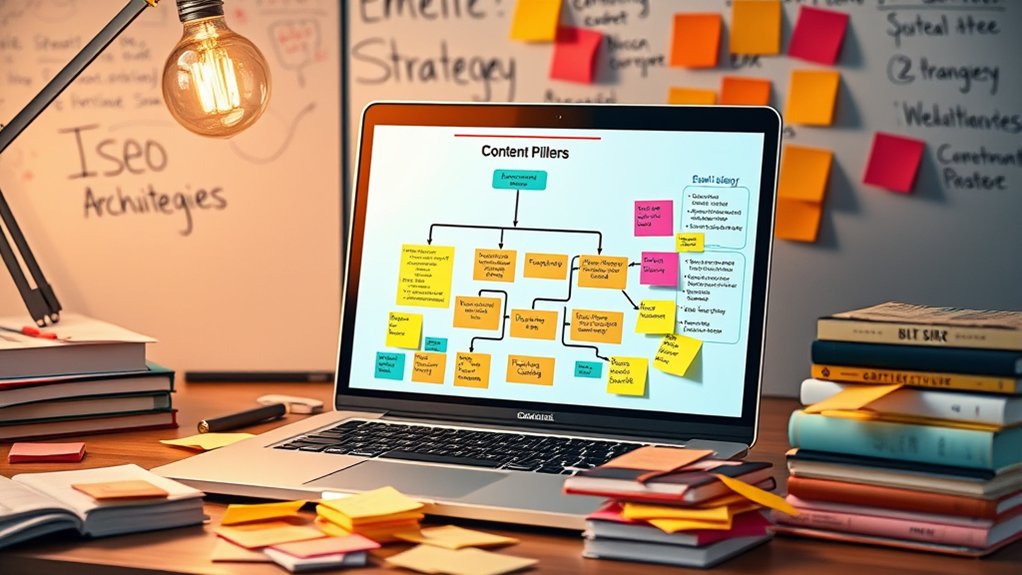
Three structural moves—pillar hubs, focused clusters, and purposeful internal links—turn scattered articles into a crawlable, high-authority knowledge system.
Pillar pages act as extensive hubs that map a topic’s breadth, then route users and bots to precise subtopics. With pillar page optimization, each outbound link uses keyword-rich, descriptive anchors that signal clear relationships and improve discovery. Clusters deepen coverage with long-tail intent, link back to the hub, and cross-link when relevance exists, reinforcing a coherent graph.
1) Map hierarchy: group keywords by SERP intent into pillars and clusters; guarantee every cluster answers a distinct query to avoid cannibalization.
2) Execute links: maintain a bi-directional hub-and-spoke pattern; use contextual, keyword-rich anchors; aim for about one internal link per 300 words to preserve equity.
3) Measure and refine: track crawl paths, indexation, and PageRank flow; monitor topical coverage via gaps and overlapping queries.
This cluster content strategy boosts rankings, improves navigation, and strengthens perceived expertise.
Step-by-Step Strategy to Build Topical Authority

While tactics vary by niche, a reliable path to topical authority follows five rigorously executed steps: identify core topic clusters with AI-driven content and SERP analysis; map the full topic universe to expose every subtopic, question, and related concept; conduct topic-based keyword research that prioritizes themes over isolated terms and captures emerging queries; develop extensive content that meets or exceeds competitor depth and is structured for extraction; and establish authority through consistent, interconnected publishing that accelerates indexing and stabilizes rankings.
Use AI to audit coverage, benchmark competitors, and visualize cluster relationships, then prioritize clusters by demand, feasibility, and business impact. Map every intent, not 10–20 keywords—meta-clustering reveals gaps. Execute topic-based research that ties head terms to long-tails and related entities, refreshed quarterly. Produce thorough, scannable content with clear headers, ordered steps, and bullet summaries.
| Step | Action Focus |
|---|---|
| Identify | AI audits, SERP gap analysis |
| Map | Meta-clusters, full intent coverage |
| Create | Structured depth, refresh cadence |
Publish consistently with strong internal linking—an authority building technique that stabilizes visibility and speeds indexing. This is the step by step implementation leaders follow.
Metrics and AI Tools to Measure and Optimize Authority

To quantify topical authority, the team sets clear Authority Signal KPIs: keyword ranking distribution, topic share, indexed pages count, cluster density, engagement signals, and SERP feature presence.
They operationalize an AI-driven optimization stack using Ahrefs Keyword Explorer with AI, Semrush Copilot, Keyword Insights AI, Topic Gap Analysis, and tools like Clearscope/Surfer and ClusterBot to score coverage and prioritize gaps.
They iterate weekly by benchmarking against competitors, updating clusters and internal links, and shipping briefs that target high-opportunity subtopics to lift share and rankings.
Authority Signal KPIS
Two categories of KPIs define authority performance: link-based strength and user-validated credibility. Practitioners treat authority measurement as a composite of trust signals: Authority Score trends, dofollow root domains, niche-relevant backlinks, spam risk, and balanced outgoing links.
Machine learning–driven scores (DA/DR/Authority Score) benchmark progress and surface unnatural profiles.
They operationalize KPIs around three tracks:
1) Link equity: track total unique referring domains, topical relevance, IP/class-C diversity, and toxic-link removals; prioritize outreach to domains outperforming competitors’ median DR.
2) Content depth and SERP proof: monitor AI-derived content depth, EEAT cues, entity coverage, internal link coherence, and featured snippet ownership per hub.
3) User validation: measure organic CTR by query intent, engagement and bounce by template, conversion rate per topic cluster, branded traffic growth, and repeat visits.
Teams iterate monthly, correlating score changes with new/losing backlinks and engagement shifts.
Ai-Driven Optimization Stack
Because authority is measurable, teams should deploy an AI-driven optimization stack that ties actions to metrics across research, creation, and technical delivery.
Use AI tools to mine keyword insights from Search Console, Keyword Planner, and competitor datasets, then apply semantic clustering to form topic hubs aligned to user intent.
Question-generation models surface subtopics that expand coverage and boost content velocity.
Operationalize optimization strategies with NLP-driven outlines, readability fixes, and keyword placement checks, while strengthening content architecture via cluster-of-clusters structures.
Add real-time freshness and factuality scoring to uphold E-E-A-T.
Leverage predictive analytics for performance forecasting: model traffic, ROI, and rising topics before production.
Monitor Share of Voice, AI overview presence, and search features via unified dashboards.
Implement technical automation for schema, semantic HTML, internal linking, site speed, and crawl health, with alerts and prioritized remediation.
Frequently Asked Questions
How Long Does It Realistically Take to See Authority Gains?
It typically takes 6–12 months to see authority gains; competitive niches may need 12–18. Strong sites can rank within hours. He should optimize internal links, publish consistently, and track authority timelines with measurement metrics: GSC, Semrush/Ahrefs, engagement, indexing speed.
What Team Roles Are Essential to Execute This Framework?
They’ll need SEO directors, strategists, content strategists, data analysts, technical SEO specialists, project managers, and creators. Each role drives KPIs, audits, automation, site architecture, structured data, content briefs, and cross-team alignment to execute, iterate, and scale measurable authority.
How Should Budgets Be Allocated Across Content, Tools, and Links?
They should allocate 50% to content investment (long-form production, AI research tools), 30% to AI SEO tools (clustering, internal linking), and 20% to link strategy (quality outreach). They’ll prioritize accuracy, automate tasks, track rankings, and adjust quarterly.
How Do You Recover Topical Authority After a Core Update?
They recover by auditing losses, prioritizing topical relevance gaps, executing content optimization, and reinforcing E-E-A-T. They refresh data, restructure hubs, tighten internal links, acquire authoritative backlinks, fix technical issues, and track recovery via impression/visibility deltas, engagement lift, and conversion-assisted rankings.
What Workflows Keep Clusters Updated Without Creating Content Bloat?
They run audit-driven refresh cycles, prioritize content pruning, and consolidate weak pages. They use semantic clustering, rigorous interlinking, and keyword optimization. AI tools suggest rewrites, test variants, and schedule updates. Metrics guide pruning vs. expansion, preventing overlap and maintaining lean clusters.
Conclusion
In today’s SERP landscape, brands win by proving depth, not breadth. By mapping pillars and clusters, aligning to semantic entities, and reinforcing relevance with internal links, teams can signal expertise at scale. They should deploy AI to surface gaps, generate outlines, and prioritize queries by intent and difficulty. Track coverage, entity overlap, link flow, and outcomes—impressions, CTR, assisted conversions. Iterate weekly. When data guides creation and architecture, topical authority compounds, rankings stabilize, and growth accelerates.
